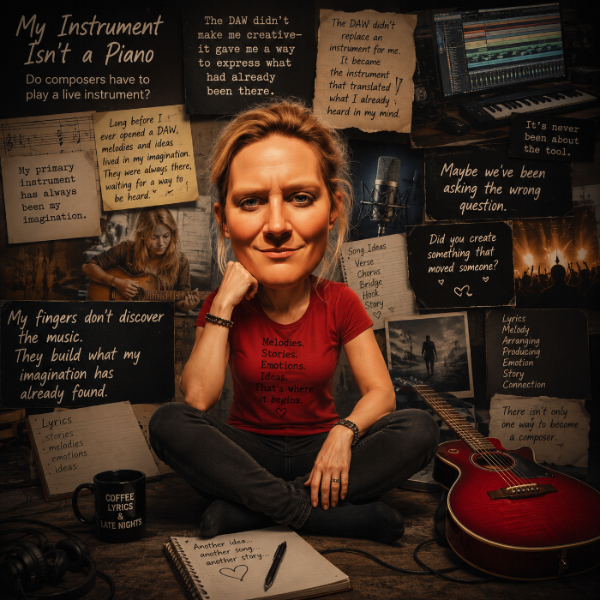

"One songwriter's journey from lyrics... to imagination... to composing in a digital world."
Do composers have to play a live instrument?
Every so often I come across a comment online that says something like:
"If you don't play an instrument, you're not a real composer."
For years, I rarely talked about how I created my music.
Not because I was embarrassed.
Not because I thought my process was somehow less valid.
But because I knew there were people who would dismiss the work before they ever heard a single note.
The assumption was simple:
"No piano? No guitar? Then you're not a real composer."
After thinking about it for a long time, I believe it's finally time to share my story.
My journey began long before a DAW.
I've been writing songs and lyrics for more than twenty-five years, but my creative journey started even earlier.
As a teenager, I had an organ and learned to play songs using a simple number-and-letter system. I couldn't read sheet music, but I loved discovering melodies. Years later I bought an electric guitar and eventually learned to play "Amazing Grace." Today, I still own a beautiful red acoustic guitar that waits patiently in the corner of my room.
I admire people who can sit down at a piano or pick up a guitar and effortlessly bring music to life.
That simply wasn't my path.
For more than twenty-five years I've been a songwriter. It wasn't until around 2013 that I discovered the creative world inside a DAW. That's where my journey as a composer truly began.
Long before I ever opened a DAW, melodies and ideas lived in my imagination. They were always there, waiting for a way to be heard. The DAW didn't make me creative—it gave me a way to express what had already been there. It didn't replace an instrument for me. It became the instrument that translated what I already heard in my mind.
People often ask musicians what instrument they play.
For me, the answer has always been a little different.
My primary instrument has always been my imagination.
Does that make me less of a composer?
I don't believe it does.
Over the years I've had music licensed for television, signed with publishers and music libraries, and selected by music supervisors for film and TV placements.
Never once has anyone asked me:
"Can you play piano?"
"Did you record a live guitar?"
"Was this written on a Steinway?"
They listened to the music.
They judged whether it fit the story.
That's what mattered.
Technology has always changed music.
This isn't a new conversation.
There was a time when synthesizers weren't considered "real."
Then came MIDI.
Digital recording.
Sample libraries.
Virtual orchestras.
Software synthesizers.
DAWs.
Each new generation of technology has been met with skepticism before eventually becoming another accepted tool in the creative process.
Today, many of the world's most respected composers build their music with computers, virtual instruments, MIDI, and enormous sample libraries before live musicians ever step into a recording studio.
Hans Zimmer once said:
"If you ask me what my instrument is, I'll tell you it's the computer."
That quote resonated with me.
Not because my workflow is the same as his.
But because it reminds us that creativity doesn't arrive through only one doorway.
Playing is a skill.
Composing is a skill.
Producing is a skill.
Arranging is a skill.
Sound design is a skill.
Songwriting is a skill.
Those skills often overlap.
But they aren't the same skill.
A brilliant concert pianist may struggle to write an original composition.
A gifted songwriter may hear incredible melodies while never performing publicly.
An electronic producer may build breathtaking soundscapes without playing a traditional instrument at a virtuoso level.
None of those paths are more legitimate than the others.
They're simply different expressions of creativity.
It's never been about the tool.
Over the years I've used loops. Virtual instruments. Sample libraries. MIDI. Software synthesizers. Plugins. And yes, today I also explore AI-assisted tools.
The tools have changed.
The goal hasn't.
Every note still has to serve the song.
Every arrangement still has to create emotion.
Every production still has to tell a story. Technology doesn't replace imagination. It gives imagination another voice.
Maybe we've been asking the wrong question.
Instead of asking,
"Did you play a live instrument?"
Maybe we should ask,
"Did you create something that moved someone?"
Because when someone hears a song that makes them cry...
Or smile...
Or remember someone they loved...
They aren't thinking about whether it started on a piano, inside a DAW, or through a collection of virtual instruments.
They're responding to the emotion.
And that's what music has always been about.
Final Thoughts
I have enormous respect for musicians who have spent decades mastering the piano, guitar, violin, cello, or any other instrument. Their dedication is inspiring, and I admire what they do.
My path simply took a different route.
My creativity didn't begin when I opened a DAW.
It began years before that, with stories, lyrics, melodies, and ideas living quietly in my imagination.
The DAW gave those ideas a voice.
There isn't only one way to become a composer.
There never has been.
And perhaps that's the beauty of music.
My fingers don't discover the music.
They build what my imagination has already found.
P.S. As I was finishing this article, I revisited a piece written back in 2015 called "Loops, Samples, and You. Are You a Poser?" It argued that using loops or samples doesn't make someone less of a composer. The real question isn't what tools you use, but what you create with them. Nearly ten years later, that message feels just as relevant. The conversation has shifted from loops to AI, but the heart of the debate hasn't changed:Does the tool create the music, or does the person using it? I believe the answer has always been the same.
Every so often I come across a comment online that says something like:
For years, I rarely talked about how I created my music.
Not because I was embarrassed.
Not because I thought my process was somehow less valid.
But because I knew there were people who would dismiss the work before they ever heard a single note.
The assumption was simple:
"No piano? No guitar? Then you're not a real composer."
After thinking about it for a long time, I believe it's finally time to share my story.
My journey began long before a DAW.
I've been writing songs and lyrics for more than twenty-five years, but my creative journey started even earlier.
As a teenager, I had an organ and learned to play songs using a simple number-and-letter system. I couldn't read sheet music, but I loved discovering melodies. Years later I bought an electric guitar and eventually learned to play "Amazing Grace." Today, I still own a beautiful red acoustic guitar that waits patiently in the corner of my room.
I admire people who can sit down at a piano or pick up a guitar and effortlessly bring music to life.
That simply wasn't my path.
For more than twenty-five years I've been a songwriter. It wasn't until around 2013 that I discovered the creative world inside a DAW. That's where my journey as a composer truly began.
Long before I ever opened a DAW, melodies and ideas lived in my imagination. They were always there, waiting for a way to be heard. The DAW didn't make me creative—it gave me a way to express what had already been there. It didn't replace an instrument for me. It became the instrument that translated what I already heard in my mind.
People often ask musicians what instrument they play.
For me, the answer has always been a little different.
My primary instrument has always been my imagination.
Does that make me less of a composer?
I don't believe it does.
Over the years I've had music licensed for television, signed with publishers and music libraries, and selected by music supervisors for film and TV placements.
Never once has anyone asked me:
"Can you play piano?"
"Did you record a live guitar?"
"Was this written on a Steinway?"
They listened to the music.
They judged whether it fit the story.
That's what mattered.
Technology has always changed music.
This isn't a new conversation.
There was a time when synthesizers weren't considered "real."
Then came MIDI.
Digital recording.
Sample libraries.
Virtual orchestras.
Software synthesizers.
DAWs.
Each new generation of technology has been met with skepticism before eventually becoming another accepted tool in the creative process.
Today, many of the world's most respected composers build their music with computers, virtual instruments, MIDI, and enormous sample libraries before live musicians ever step into a recording studio.
Hans Zimmer once said:
That quote resonated with me.
Not because my workflow is the same as his.
But because it reminds us that creativity doesn't arrive through only one doorway.
Playing is a skill.
Composing is a skill.
Producing is a skill.
Arranging is a skill.
Sound design is a skill.
Songwriting is a skill.
Those skills often overlap.
But they aren't the same skill.
A brilliant concert pianist may struggle to write an original composition.
A gifted songwriter may hear incredible melodies while never performing publicly.
An electronic producer may build breathtaking soundscapes without playing a traditional instrument at a virtuoso level.
None of those paths are more legitimate than the others.
They're simply different expressions of creativity.
It's never been about the tool.
Over the years I've used loops. Virtual instruments. Sample libraries. MIDI. Software synthesizers. Plugins. And yes, today I also explore AI-assisted tools.
The tools have changed.
The goal hasn't.
Every note still has to serve the song.
Every arrangement still has to create emotion.
Every production still has to tell a story. Technology doesn't replace imagination. It gives imagination another voice.
Maybe we've been asking the wrong question.
Instead of asking,
"Did you play a live instrument?"
Maybe we should ask,
"Did you create something that moved someone?"
Because when someone hears a song that makes them cry...
Or smile...
Or remember someone they loved...
They aren't thinking about whether it started on a piano, inside a DAW, or through a collection of virtual instruments.
They're responding to the emotion.
And that's what music has always been about.
Final Thoughts
I have enormous respect for musicians who have spent decades mastering the piano, guitar, violin, cello, or any other instrument. Their dedication is inspiring, and I admire what they do.
My path simply took a different route.
My creativity didn't begin when I opened a DAW.
It began years before that, with stories, lyrics, melodies, and ideas living quietly in my imagination.
The DAW gave those ideas a voice.
There isn't only one way to become a composer.
There never has been.
And perhaps that's the beauty of music.
My fingers don't discover the music.
They build what my imagination has already found.
P.S. As I was finishing this article, I revisited a piece written back in 2015 called "Loops, Samples, and You. Are You a Poser?" It argued that using loops or samples doesn't make someone less of a composer. The real question isn't what tools you use, but what you create with them. Nearly ten years later, that message feels just as relevant. The conversation has shifted from loops to AI, but the heart of the debate hasn't changed:Does the tool create the music, or does the person using it? I believe the answer has always been the same.